
Intro: Lore Abiding Citizen
Every MechWarrior has a first real project, that moment when you stop treating your miniatures like test pieces and start painting something meaningful. For me, that moment came somewhere between chapters of Michael A. Stackpole’s Warrior Trilogy. Inspired by the legendary exploits of the Kell Hounds during the Succession Wars, I decided it was time to bring those iconic colors to life on my own workbench.
Choosing the Hounds
I was only just learning about the Kell Hounds and I was drawn in by characters like Daniel Allard and Morgan Kell. I choose them as my first real unit to put paint to. The fact that as a legendary mercenary unit they could conceivably show up anywhere in tabletop scenarios was an added bonus.
Building a Lore-Accurate Kell Hound Lance
Once I knew I wanted to paint the Kell Hounds, I wanted to make sure my choice of ‘Mechs matched the era and unit I was reading about. As I mentioned before, I was deep into The Warrior Trilogy by Michael A. Stackpole, so the Succession Wars period was my target timeline. To help with accuracy, I tracked down a digital copy of the Kell Hounds Scenario book, originally published by FASA in 1988.
That book is a treasure. It’s part roster, part history, and full of classic art and flavor from the early days of BattleTech. Between the ‘Mechs piloted by characters like Morgan Kell, Patrick Kell, Cat Wilson, and Daniel Allard in the novels, and the unit listings in the sourcebook, I put together a roster that felt both authentic and flexible for the tabletop.
The lineup I chose includes:
- Archer
- Thunderbolt
- Marauder
- Orion
- Blackjack
- Shadow Hawk
- Wolfhound
- Stinger
- Cyclops
It’s a solid mix of classics across different tonnages, and roles. More importantly, it feels like Succession Wars Era Kell Hounds; reliable, balanced, and ready to take on anyone from the Genyosha to the Death Commandos.

(Image: FASA’s 1988 “The Kell Hounds”)
Finding a Technique That Works for Me
I’ll be honest: I’m a total newbie painter, and BattleTech has really been the catalyst that got me into the hobby. I’m not a naturally patient painter either. I love the creative part, but I’m usually eager to get to the finished product. After experimenting with a few approaches, I found a process that balances speed with results I’m proud of — a Slap Chop-inspired technique.
Here’s the workflow that’s been giving me the best results, and a few thoughts on why each step works for me as a new painter trying to strike the right balance between efficiency and appearance:
- Prime with Army Painter’s Black spray Primer, followed by a Uniform Gray zenithal coat. This creates natural shading and helps me visualize where the light would hit the ‘Mech.
- Drybrush with Citadel’s Praxeti White to build subtle highlights that make the following colors more vibrant. It’s quick, satisfying, and adds a ton of visual depth.
- Apply Contrast Paints: For the Kell Hounds scheme, I went with Basilicanum Grey and Flesh Tearers Red from Citadel’s Contrast line. These paints flow nicely into the recesses and make the panels stand out, giving me solid results without too much fuss.
- Cockpit Glow: A layer of Warpstone Glow for that signature emerald shimmer. I love this part—it’s a small pop of color that immediately gives life to the miniature.
- Metal Details: For a lighter metal contrast, I used Grey Death Acrylic from Army Painter’s BattleTech Mercenary Paint Set (The color match is Ash Grey). Touching up the joints, barrels, and vents helps the model feel more complete and grounded.
This combination gives me depth, color separation, and a finish that feels both lore-accurate and battle-ready. It takes me from a blank hunk of plastic to something that looks like it belongs in the Inner Sphere without spending hours layering and edge-highlighting each panel.

(Image: Primed and dry brushed)
A Jumping Thunderbolt Challenge
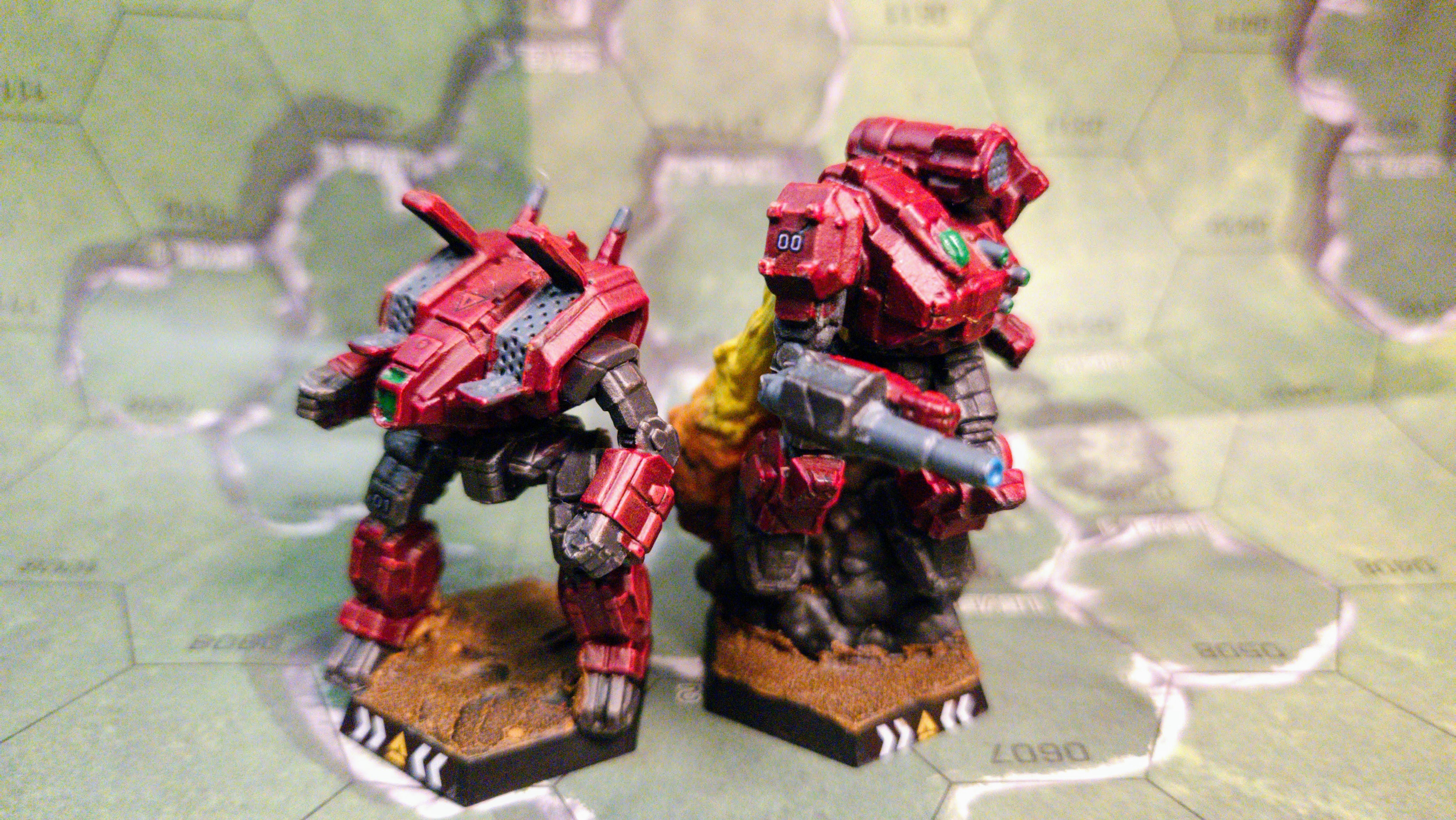
One of the highlights of this project was painting a Thunderbolt in mid-jump. This miniature was a real challenge for me, pushing my limited skills in shading and blending. I used red, white, orange, and black acrylic paints, layered carefully to capture the intense heat and smoke of the jump jets. To tie it all together, I added a Light Combat Wash from the BattleTech Mercenaries Paint Set to bring out the depth and soften transitions between colors.
This piece became a small experiment for me. I wanted it to feel like the Thunderbolt’s boosters were ablaze as it arcs across the battlefield. Despite my inexperience, I’m really happy with how it turned out, and it stands out as one of my favorite models in the force.

(Image: rear shot of the jumping Thunderbolt with jet plume effects.)
Basing and Finishing Touches
For the base, I kept things simple and consistent. Vallejo Diorama FX Earth Texture sets the ground, followed by a generous coat of Citadel Agrax Earthshade to bring out that gritty, muddy realism I love. It’s quick, forgiving, and gives a great battlefield look without a ton of effort.
Finally, no Kell Hounds ‘Mech is complete without proper unit markings. I used Defiance Industries Wargaming decals — their Kell Hounds Premium Set and Hex Front Markers line along with some number decals. They really make the minis pop and give them that professional, in-universe finish. After applying the decals, I seal everything with a coat of AK Matte Varnish to protect the paintwork and better integrate the decals. Once the varnish has dried, I use Citadel Colour Technical Ardcoat on the cockpits and lenses to give them that glossy, glassy finish.
Seeing the miniatures come together during this stage is always rewarding. The textures, varnish, and final details take the models from looking like painted toys to small pieces of a battlefield frozen in time. These finishing steps pull the whole force together visually and make the Kell Hounds feel cohesive as a unit, ready for deployment.

(Image: finished units on bases with decals applied)
Commander’s Notes
This project was a small milestone for me . It was the moment I went from painting generic or test mechs to building something from BattleTech lore. The process was fast, satisfying, and a great reminder that you don’t need to be an expert painter to field a force that looks good and feels right.
What surprised me most was how much I came to appreciate the depth BattleTech’s lore adds to the hobby. Painting lore accurate units made the process more engaging and rewarding.

(Image: A lance of the Kell Hounds deployed on a grasslands battlefield.)
Leave a Reply